
Bridges of Baseball
Be the first to read long-form baseball stories delivered monthly.
The Eternal Game?
Is there something more to the game? Drawing on Augustine, Origen, and an Oxford theology degree, ethicist and scholar Caleb makes the case - from the Elysian Fields to Iowa's cornfields - that America's pastime has always been reaching for something transcendent.
On August 13, the Philadelphia Phillies face the Minnesota Twins in the third installment of MLB's Field of Dreams Series, played at the movie site's diamond in Dyersville, Iowa - echoing the film's vision of those passed returning through the cornfield to play the game again.

Could baseball be more than a game, a sport, or a pastime? Does it somehow involve something transcendental—something eternal? Inexplicably, I’ve long been unable to shake the feeling that it could and does.
Of course, I’m far from the first to possess such a conviction. Aside from classic jokes premised on baseball games being played in heaven, consider the spiritual, mythical, or ethereal themes of popular works of baseball-inspired art such as The Natural, The Year the Yankees Lost the Pennant, and Angels in the Outfield. The paradigm of such works, of course, remains the film The Field of Dreams, based on W.P. Kinsella’s novel Shoeless Joe, which depicts heaven mysteriously, but quite literally, intersecting with earth on a baseball field carved into an Iowan cornfield by a farmer faithful to a commanding voice from above. And in the more recent film, 42, it is nothing other than the affinity of God himself for baseball that Harrison Ford’s Branch Rickey invokes in rebuking the general manager of the Phillies when he threatens not to field a team against the Dodgers on account of Jackie Robinson.
Further, baseball’s founding legend is undeniably quintessential mythological Americana. At its center is the son of a man named Ulysses who would become a distinguished soldier and fire the first shot of the Civil War (truly), one Abner Doubleday. The legend conceives of Abner, then only a plucky West Point cadet, brilliantly creating the game and its bespoke rules ex nihilo in an Edenic pasture in upstate New York.
But are baseball’s true origins any less mythological?
Today, it is commonly agreed that the first distinctly recognizable, documented baseball game was played on a June day in 1846 by the New York Knickerbockers, led by Alexander Cartwright, and another club, the New York Nine. An eyewitness player in that inaugural game would, years later, recollect that on that fateful day “the sun shone beautifully,” and never did he “remember noting its beams fall with a more sweet and mellow radiance than on that particular Spring day.” And where was this decisive game played? On Hoboken’s Elysian Fields—which, perhaps providentially, derived their name from the paradise of Greco-Roman mythology described by Homer and a host of other ancient poets. For decades previously, the game itself represented a reverse Tower of Babel in New York City—attracting the many languages, cultures, and immigrant communities of the city, eventually coalescing around a common set of rules, commerce, and star players (as Kevin Baker’s The New York Game argues). It is no wonder then that scholars regard baseball as the most mythologized sport in American culture.
During my years of study at Oxford, I had the privilege of playing for and helping to captain the university’s baseball team—a team whose diverse members were united not by ethnicity, but by a shared love of the game. Memories of that time, along with the relationships formed on and around baseball diamonds or village greens across the United Kingdom, constitute some of the most precious treasures I carried home with me to America. Those experiences, paired with my concurrent graduate studies in theology, unexpectedly revealed the transcendental nature of this transcontinental game, which has deepened my love for it and illuminated its unique power to connect strangers.
For starters, I spent many nights after practice in the intellectual company of a famous theologian and churchman who perished long before Cartwright and his friends walked upon the Elysian Fields. But at the center of the theological framework of Augustine of Hippo is a wondrous idea: those who know and love the Son of God are akin to pilgrims, who spend their lives as a motley band, journeying together towards their true home and origin—the heavenly and eternal City of God, where ecstatic communion with the Triune God who created them awaits. It occurred to me then that at the dramatic heart of baseball lies a recurring question akin to Augustine’s central insight: can each player who reaches base make it safely home again? In this sense, baseball may be a parabolic sign of a greater reality—pointing beyond itself to the deepest human longing: to make it safely home, where joyous celebration awaits those who faithfully overcome the perils of this temporal life.
Second, I discovered amongst the early Church fathers a proclivity to see significant meaning and revelation contained within all of the Scriptures, perhaps especially in the numbers that the biblical authors employ when describing particular events. Numbers that, at first blush, appear to have no significance beyond their literal meaning. But not so, said many an early theologian. Origen of Alexandria, for example, examined the story of the wedding at Cana in the Gospel of John, and beheld explicable and important meaning in the number of firkins of water (3) contained within the stone jars (as pointing to the nature of man as a unity of mind, body, and soul). Similarly, he saw the central Christian doctrine of the Trinity indicated by the number of divine beings (3) described in the sixth chapter of the Book of Isaiah. Challenged by Origen and others to look at the mundane afresh with penetrating eyes, I couldn’t help but notice that baseball is clearly centered around the number 3 and its multiples: 3 strikes, 3 outs, 3 bases, 3 outfielders, 3 basemen, 9 innings, 9 players, and 90 feet between bases.
As the baseball writer Douglass Wallop once wrote, baseball magnates have historically made little of “this aspect of triplicity,” despite being quick “to identify their game with patria.” Accordingly, he noted that “they have so far resisted, at least in public, any temptation to say [baseball] has the solid backing of the Trinity.” But would Origen counsel them against yielding to this “temptation” to note such divine imprimatur in light of baseball’s numerological pedigree? I’m increasingly unsure that he would.
Third, I began to notice just how integral public worship and prayer are to baseball. Consider this: how many times have you seen players look gratefully, and extend their hands prayerfully towards the heavens, as they approach home plate after a leisurely, but joyous, home run trot? And it’s not just after home runs that this occurs. Pitchers frequently clutch the religious symbol on their necklaces after a critical strikeout and fielders can often be spotted offering a quick prayer of thanks after a game-winning out is nimbly secured. This reality may just be a vestige of baseball’s peculiar traditions, but it may also be the result of playing each game on a beautiful plain—where no man-made obstacle exists overhead to prevent you from gazing straight into the heavens and beyond.
Perhaps there is also something primordial and innate triggered within us by a verdant, well-tended field that unconsciously reminds us of our origins (if the Book of Genesis is to be believed) —as gardeners contentedly living in close proximity to a loving Creator.
Finally, even after the introduction of the pitch clock, a baseball game—unlike any of the other strictly time-capped major sports in the Americas—could, in theory, take a whole eternity to play. Indeed, the longest major league game on record by innings, a 26-inning showdown between the Brooklyn Robins and the Boston Braves on a spring day in 1920, ended only on account of the sun having set, making it too dark to play. Infielders Chuck Ward and Charlie Pick hit a combined 0-21 at the plate, and both starters went a combined 52 innings in a true pitcher’s duel that would end in a 1-1 tie.
Nowadays, reflecting upon this historic game calls to my mind the ending of the Book of Revelation. In Revelation’s penultimate chapter, the Seer of Patmos beholds, beyond time and judgment, a heavenly city that comes to a redemptively reconstituted earth upon which there is no longer need for a sun, for the glory of God is the only required illumination.
Of course, not all baseball fans and players are religious, or would frame their love of the game in theological terms. But, if at the heart of this great game lies something transcendental, the transnational and transcultural allure of baseball suddenly becomes more explicable. And the feeling that many of us have had as we have taken our positions on a neighborhood diamond or taken our seats in a vintage ballpark, that we are somehow participating in something more than just a mere game or entertainment, begins to make perfect sense.
The feeling that a baseball game truly could go on for an eternity. And perhaps, one day we will make the delightful discovery that one will.
Edited by Trevor Gomes
For more from Caleb,
click the button below to read his “New World Order of Baseball” article for Providence Magazine - reflecting on new geopolitical trends coming out of the 2026 World Baseball Classic.
Learn More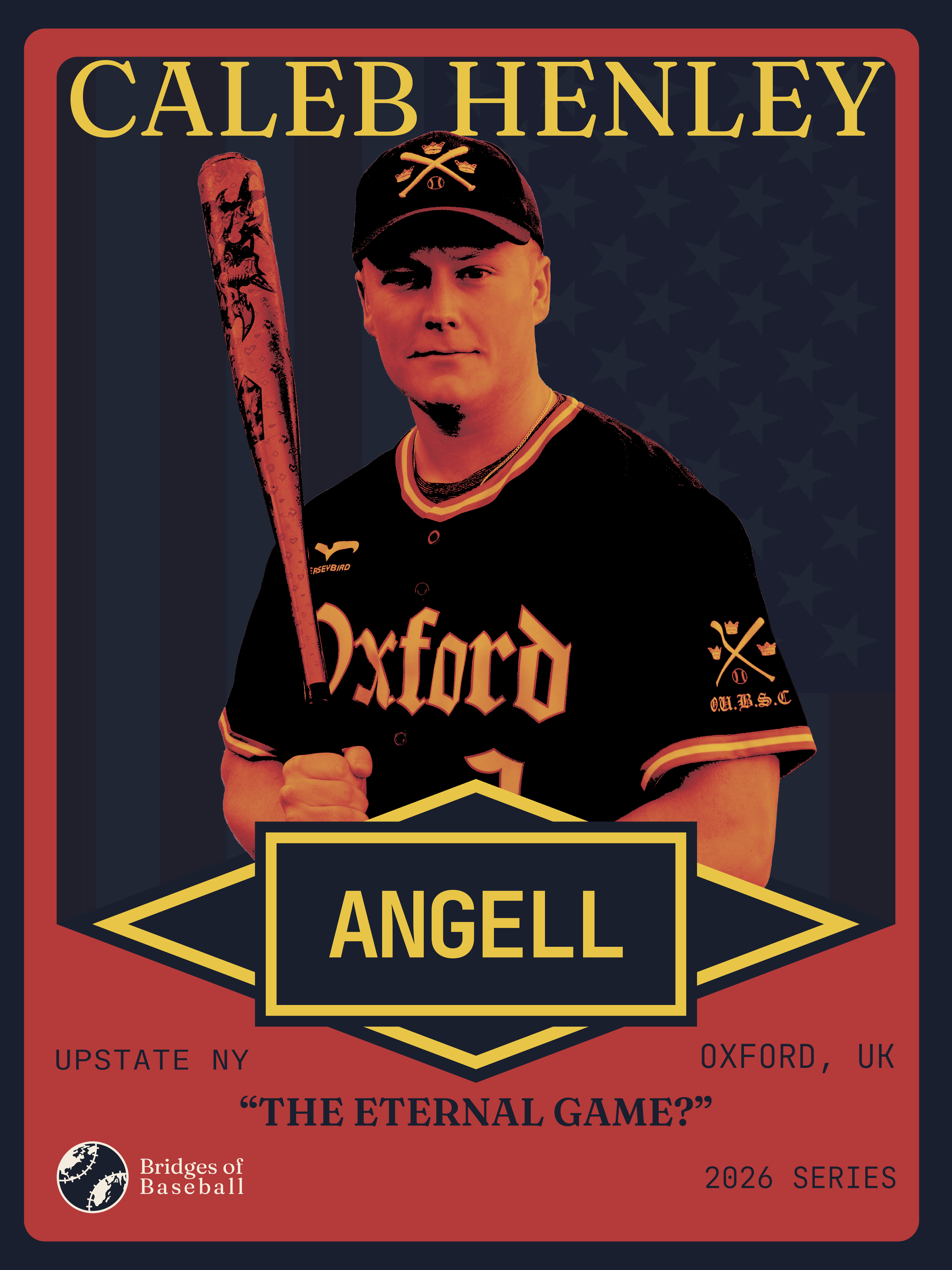

Bridges of Baseball
Stories only baseball can tell.




© 2026 Bridges of Baseball · All rights reserved