Bridges of Baseball
Be the first to read long-form baseball stories delivered monthly.
The Long Season
In a year that brought Maduro's capture, Venezuela's first World Baseball Classic title , and earthquakes that claimed the lives of thousands, a Venezuelan beat reporter covering the Red Sox tries to answer a friend's simple question: what's the most important thing you've seen this year?
Section I
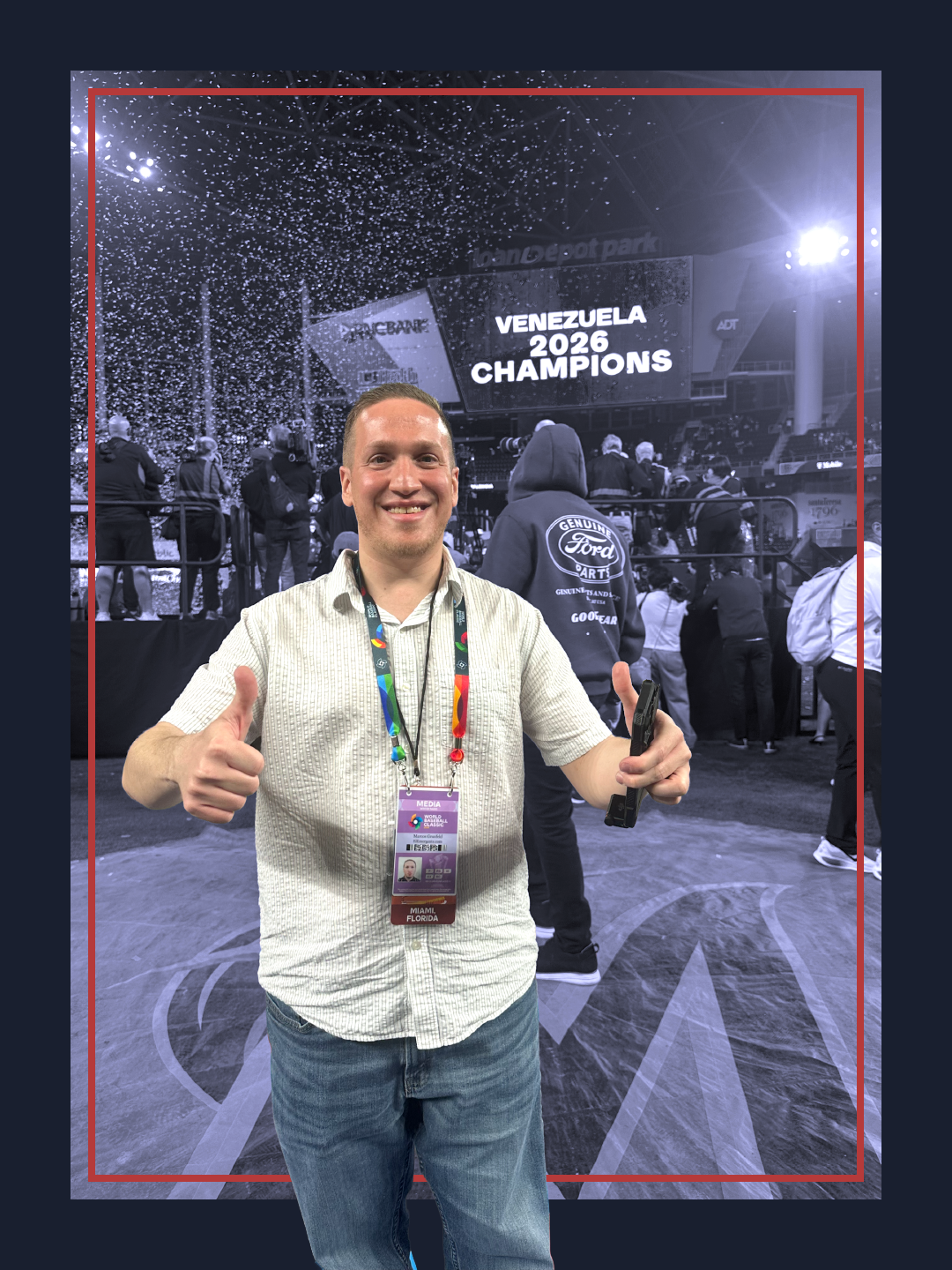
In the World Baseball Classic (WBC) championship game, I was going down from the ballpark’s press box to the main floor to see a friend I hadn’t seen in several years. When the elevator doors opened, I suddenly felt like I was at the stadium in Caracas, which I had last visited in 2019.
My friend and I spent some time together that day. We still have a good friendship even though we don’t live in the same place anymore. A few days ago, he asked me: “What do you think is the most important thing that you have seen this year in Venezuela?”
I paused and started thinking.
Sometimes it feels like something is always happening in Venezuela. We’ve been feeling that way for almost 30 years, since Hugo Chavez took office in 1998.
That’s why people are always discussing something.
Before social media, people discussed things with their family and friends. For almost two decades, it’s safe to say Twitter/X has been a platform where Venezuelans constantly debate politics, baseball or world events, even hundreds of miles from home for people like me in Boston.
There are currently a lot of discussions regarding the recent oil agreement between Venezuela's interim government and the Trump administration.
Though this has been a big year for Venezuela even beyond that.
On January 3rd, we were still recovering from the New Year celebrations when we found out that a U.S. law enforcement operation ended with the capture of the country’s former president, Nicolas Maduro, and his wife, Cilia Flores.
A couple of months later, Venezuela won its first World Baseball Classic championship.
“We had the whole country of Venezuela behind our backs,” Willson Contreras told me after rejoining the Boston Red Sox spring training facility following the WBC victory. Spirits were high going into Opening Day with a Red Sox team filled with Venezuela superstars like Contreras, Wilyer Abreu, and Ranger Suárez. At the time, FanGraphs writers picked them and the Blue Jays as most likely to win the AL East division.
It was the first time in a long while that the country was united. You could feel it back then at LoanDepot Park, where the energy during Venezuela’s games was simply different.
Section II
Few countries outside the United States claim baseball as their national pastime. Venezuela is one of the exceptions, even though all of its neighbors love soccer. For us, baseball is huge. The atmosphere that we saw in Miami during the World Baseball Classic is what going to a baseball game in Venezuela looks like.
At some point in the previous decade, attendance at Leones del Caracas games was over 10,000 every night. But if there was a Caracas vs. Magallanes game, which is the equivalent of a Red Sox vs. Yankees game, there could be up to 25,000 people at the ballpark.
Obviously, ballparks in Venezuela are small, so 25,000 people is a lot down there.
You can go to YouTube and search for a home run that Gregor Blanco hit against star reliever Francisco Rodriguez in a championship series between Caracas and Magallanes in 2010.
I was there that day. It was the ninth inning in the fourth game of the series. Blanco tied the game, and Caracas, which was down 2-1 in the series, ended up tying the series and winning two of the next three games to claim the ring.
That home run was the most amazing atmosphere I had ever experienced live at a game—until the 2026 World Baseball Classic championship game. It was amazing to feel that again after everything we have been through.
I really respect the idea behind journalism, including even the limitations. You have to behave as a journalist, not a fan. So this will be the first time I’ll admit this in public: I was a Caracas fan when I was a kid.
So beating Magallanes in 2010 was a big deal, but I had to contain my public excitement and enjoy it by myself, because I was already working on the beat. Around that same time, my dad first got sick, right as I was finding my footing in baseball and journalism. Balancing the roles we each hold is a discipline I learned early, and more than once—through my dad, and through covering players who perform through adversity.
Section III
Unfortunately, reality hit us again three months after the WBC.
It started with sudden pick-up on social media, then a few videos started emerging. One earthquake, maybe a second—initially reported somewhere in the northeastern part of Venezuela.
I thought immediately about my sister, my friends, my family in that region and around the country. Thankfully my sister got in touch and assured us she was fine.
Then the rest of the details and scenes emerged. I became aware of the scale of the destruction and tragedy: thousands of deaths, and people still missing today. My sister had been in her apartment building’s parking lot next door when they hit. She was one of the fortunate ones.
People in Venezuela and around the world worked together to find as many people alive as possible and to send as much help as possible, with money, donations, and supplies.
For the first time in a long time, people across the country were together, not discussing ideas or baseball. We were together to help each other.
“We have been living on a roller coaster,” Wilyer Abreu told me in Spanish. “Because of everything that has been through in our lives. I think things have improved. The good thing is we always want to keep moving forward with enthusiasm. We never give up because of the difficulties that we have been through. That’s what allows us to keep going. We are warriors.”
The earthquake proved exactly that. It was impressive to see people remove the rubble with their own hands to try to save as many lives as possible.
San Francisco Giants rookie Víctor Bericoto knew that there had been an earthquake in Venezuela before playing that day. But he didn’t know how big it was.
That day, he was the hero, recording his first MLB walk-off home run.
Then, when he went to call his family to share the moment, he found out that his brother’s girlfriend had died during the earthquake.
“We should love our loved ones and enjoy every day because we don’t know what could happen tomorrow,” the rookie said in Spanish. “Only Venezuelan people know everything that we have been through in the past few years. It’s been tough, but we are hard workers and that helps us to fight for what we want.”
For the first time in a long time, Venezuelans weren’t discussing or fighting over a social media post. The earthquakes, as happened with the World Baseball Classic, proved that people at home can put their differences aside and work together for the good of the country.
It was hard to simply sit at home miles away and watch all the videos on social media. Buildings collapsing and people asking for help. But once I went back to Fenway Park to resume my work covering the Boston Red Sox, it was incredible to see all the kindness and help from everybody in this community.
The Venezuelan-born players on the team, alongside Boston legend David Ortiz and others, went out to Jersey Street to help raise money for the victims, just one hour before the first pitch. Red Sox owner John Henry also approached the players on the street to support them. The Red Sox were 35-46 at the time, good for last place in the AL East. But that moment on Jersey Street was awesome.
As the summer drew to a close, earthquake relief efforts remain while the next rounds of politics and economics fill the space. This time, it’s regarding the oil deals announced between the U.S. and interim Venezuelan authorities. The debates, and divisions, continue.
Section IV
It’s late in September now, and it’s almost midnight. I’m still in the Fenway Park press box, where I have spent most of my days over the past five months.
There have been happy days and bad days over the past few months. Earlier this month, I took a whole week off for myself, because I hadn’t stopped since the World Baseball Classic led right into Opening Day.
March was first when my friend challenged me to answer what’s the most important thing I’ve seen this year in Venezuela. Never could any of us have imagined, to borrow a phrase from Wilyer Abreu, how much of a roller coaster of a year and season it’s been. For my country, and for the Red Sox.
But that’s life, I guess.
Three months ago, the Red Sox had less than a 10% chance of making the playoffs, especially after being swept by the Colorado Rockies in Denver, by all means the worst team in baseball this year.
Later over the summer, the Red Sox had an unprecedented run—winning 15 games in a row. Overall, they went 32-5 from June 25 to August 7, which included the best 30-game stretch of games in Boston Red Sox history.
And now, in just a few hours, I will travel to New York for my first-ever postseason coverage. A few hours ago, I got my credential to cover those games.
Life can change really quickly, in just the blink of an eye.
I have learned that in multiple ways over the past few years, since I was told that my dad had cancer in 2011 and then he passed away a year and a half later. Venezuelans experienced that exactly three months ago when two earthquakes hit our home, and we still don’t know the exact magnitude of that tragedy. In both scenarios, it takes years to figure out what side we come out on.
And the Red Sox have learned that this year, too. Two good streaks, and they can now fight to get their fifth World Series ring since 2004.
I don't know what the next twelve months hold for Venezuela either. Whether the arguments get louder again. Whether there's another morning like the one after the earthquake. Whether the next thing that brings us together is a reason to celebrate or a reason to grieve.
Whether in Caracas or Boston, I've spent this year—every year—trying to do the same thing: observe when I want to feel. Write when I want to cry. Behave like a journalist, not a fan.
I watched Bericoto in San Francisco do it after some of the worst news of his life. I don't know how he did it. I don't know if I could.
You can't always do both: to perform and to be yourself, the individual. We try anyway.
And if my friend asked me again, I wouldn’t point to one thing, or even to any moment in the past. I'd tell him there's always a next day. Another game, another headline, another door to see what's on the other side.
I close the laptop and hang my Sox hat on the rack. Tomorrow, each will be needed. We have a big series coming up. Red Sox-Yankees, in the Bronx, for a best of three.
The work continues.
Edited by Trevor Gomes




© 2026 Bridges of Baseball · All rights reserved