




All Stories
/
Essays
How Failing to Reach Koshien Shaped My Life in Baseball
He spent years chasing the Koshien dream. What he found outside the lineup became the real lesson and journey.
Written By
Isamu Nagano
Published
September 4, 2026
1951 usa v. venezuela
Part I:
When I was 15 years old, in my final year of junior high school, I began choosing which high school I wanted to attend.
I played on my junior high school baseball team, where I was the captain and cleanup hitter. We won our local district tournament and finished third in a Hokkaido-wide tournament. By then, I had developed a strong desire to reach Koshien, the stage every high school baseball player in Japan dreams about.
Koshien is the name of Japan’s national high school baseball tournaments, held every spring and summer at Hanshin Koshien Stadium. It’s not an exaggeration to say these tournaments can attract as much attention as professional baseball. The tournament even temporarily exiles the Hanshin Tigers, who play their home games elsewhere during the stretch. In the summer, schools fight through regional qualifying tournaments for the right to represent their area on the national stage. Schools and communities rally around their representative, celebrating every win and sharing every loss. Every game of the national tournament is broadcast across Japan. From children to the elderly, almost everyone in Japan has seen Koshien at least once.
That dream of Koshien shaped my high school decision.
I had received some recruiting interest from several local public high schools, but instead I attended tryouts at powerhouse programs that regularly competed for Koshien. I think I went to around ten of them. At none of those tryouts did I receive a particularly enthusiastic offer. I knew myself that I was not an exceptional player.
Still, I wanted to play baseball at a high level for a team that had a realistic chance of reaching Koshien, so I chose Komazawa University Iwamizawa High School.
The program had reached the semifinals of the South Hokkaido tournament three years in a row and was already considered one of the region’s strongest teams. The year I entered high school also happened to be the year the school moved to the North Hokkaido qualifying region—generally considered slightly less competitive than South Hokkaido. Many people believed our school would have a strong chance of reaching Koshien.
When I arrived, the baseball program rostered over 100 players. Just imagine: that’s almost a full line-up of players competing for each individual position.
Most practices catered to the varsity team when I first arrived in high school. The freshmen spent much of batting practice collecting baseballs or running outside the field, and we had relatively little time to actually play baseball on the main field. At the same time, there were some in my class already practicing with the varsity team, a group that played at an extremely high level.
Some pitchers threw more than 90 miles per hour and others were already receiving attention from Nippon Professional Baseball (NPB) teams.
I remember wondering whether I could ever become a regular player on a team like this. At the time, I could not even imagine it. I had never even heard of many of the team’s baserunning and defensive strategies.
Even during warm-ups, the entire team moved in unison. Their steps matched. Their voices matched. Something about the way the team carried itself made it feel like a strong program.
I entered high school in April, and by June, the qualifying tournament for Summer Koshien had begun. Our team continued to win, and by the end of July, we had qualified for Koshien.
Part II:
Once the team secured its place at the tournament, the varsity team eventually left school to begin preparing.
The climate in Hokkaido, where our school was located, is very different from that of Hyogo Prefecture, where Koshien Stadium is located. To adjust to the heat and humidity, teams from Hokkaido often travel to the area around 10 days to two weeks before the tournament begins.
Here in Japan, this is what baseball means to us and our culture.
Once the varsity team left, the junior varsity players finally had the entire field to ourselves.
That period was hell.
When Summer Koshien ends in August, it marks the end of most third-year high school players’ baseball careers.
A new team made up of first- and second-year players takes over after Koshien. The fall tournaments that influence selection for the following spring’s Koshien begin soon afterward, so the JV players began preparing for the new season in August.
The varsity team was gone. School was on summer break. There was almost nothing stopping us from practicing all day.
Warm-ups began at 8:00 in the morning and lasted about an hour. The exercises were not just designed to raise our body temperature, but also to improve hip mobility, short sprints, and core training.
Even the sprinting was designed to resemble game situations whenever possible. A pitcher might go through his delivery while the runners practiced their starts, turning a simple sprint into a simulated stolen-base attempt.
After that came throwing.
As I remember it, we did long toss almost every day. We used a running start and tried to use our entire bodies to throw the ball as far as possible. Then we moved closer and worked on quick exchanges. We intentionally threw short hops so our partners could practice fielding them. We worked on catching the ball and getting rid of it immediately with quick throws. On repeat. We also divided into groups of four and practiced cutoff and relay plays. Every day. No exceptions.
Baserunning came next. We practiced sliding and trained ourselves to lean our bodies toward the inside of the base when rounding it, minimizing the effect of centrifugal force and shortening our running path as much as possible.
Hitting is often unpredictable because your ability to score depends heavily on the opposing pitcher. Pitching and defense—areas a team could control more consistently—were therefore seen as essential. This is especially true with Japanese high school baseball, which mostly consists of single-elimination tournaments.
Baserunning was considered just as important as pitching and defense. Even if you could not hit, you might draw a walk, steal a base, and then take an extra base on a single. That could be the difference between scoring a run and not scoring at all.
By the time we finished baserunning practice, the morning was over. Then, the afternoon began with defense and the fungo drills began. Infielders fielded ground balls, threw to first base, and practiced turning double plays. Outfielders fielded ground balls and fly balls and made throws to second, third, and home. A universal team ritual for ballplayers, of all ages and all ethnicities around the world of baseball. But because of the crowded JV roster, that drill alone for us would take more than an hour.
With 70 players involved, it may not have been the most efficient. But all of us were expected to concentrate on every single ball. That created intense pressure even during practice. Teammates or coaches would immediately point out careless plays. If the players stayed silent, a coach would tell us, “Say something.”
We were constantly taught: “If you leave a bad play uncorrected, the team stays bad. If you cannot tell someone when something is wrong, neither the team nor the individual will improve. Do not see something wrong and pretend you did not.”
That lesson still influences how I work today. Do not look the other way. If something is wrong, say that it is wrong. In any diamond or workplace, some things are difficult to say but still need to be said. A team in which no one is willing to point out problems will struggle to improve.
Next came the part where mistakes got pointed out even louder. We divided into a baserunning group and a defensive group. The baserunners ran at full speed, treating every play like a real game and aggressively trying to create a run. The defenders had to respond to each situation correctly with runners moving around them. Again, if something went wrong, we stopped and addressed it. Sometimes everyone gathered around the mound to review the situation.
“Where should the first baseman be in this situation?” “Should he be the cutoff man?” The entire team would analyze these details together.
Only after all of that—around hour five or six on the field—did batting practice finally begin.
With so many players, even batting practice had to be carefully organized. We were divided into multiple groups: one hit on the field, another took batting practice in the cages, and others played defense, threw batting practice, practiced bunting, worked on baserunning by reading the ball off the bat, or did strength and conditioning. We rotated through each station every seven or eight minutes.
Finally, we cooled down, stretched, and finished the official team practice. By then, it was around 5:00 p.m. We returned to the dormitory, ate dinner, and cleaned the dorm. Almost all of the baseball players at my high school lived there.
We began individual practice once we finished cleaning.
There were only 18 spots on the tournament roster at the time. Today, the limit is 20. Everyone was trying to earn one of those spots.
A teammate and I set a goal of taking 1,000 swings a day. I hadn’t been producing results at the plate, so I was trying to improve my hitting through repetition.
One of our coaches often said: “If you run from it, it will chase you.”
His point was that if you keep avoiding your weaknesses and the difficulties in front of you, you’ll eventually face that same obstacle again. So face it now. Do not run from the problem in front of you. Confront it.
I believe the same principle applies to work, relationships with colleagues, friendships, and family. Even after I left competitive baseball, words like these from my coaches remained the foundation of how I think.
By the time we finished practicing, it was already past 8:00 p.m.
There was almost no energy left for anything else. One of my roommates would finish practice, take a bath, and then, as bedtime approached, put his baseball clothes back on.
I thought he had lost his mind.
He looked at me completely seriously and said: “I’m getting dressed now so I can sleep one second longer tomorrow morning.”
That was how intense the environment felt, in all of our pursuits for Koshien.
Eventually Koshien began, and the JV team also traveled to Hyogo Prefecture. I thought the hard training might finally slow down, but our coaches rented a field in Hyogo and kept us practicing. I remember wondering when we would ever be able to escape it.
Then the varsity team played at Koshien, the first game I had ever attended there. I was deeply moved – and remembered what my goal was. “I want to play here.”
We lost the game, but there was no question in my mind that Koshien was a special place. My ambition to play at Koshien grew even stronger.
Part III:
After Koshien, the new team officially began. Year 2.
The freshmen and sophomores who had been with the varsity team rejoined us. They were surprised by how much the JV players had improved. And those of us who had stayed behind believed that no other team could possibly have practiced as much as we had. By September, the fall tournament began, with teams trying to build a résumé strong enough to be selected for Spring Koshien.
I did not make the 18-player roster for the Spring. The team went on to win the Hokkaido tournament and earned a place in Spring Koshien, where they narrowly lost in the first round.
Then the summer qualifiers began.
Again, I did not make the roster and watched the team qualify for Koshien for the third time since I had entered high school.
I knew I wasn’t the next Ichiro or anything, but I came into Komazawa University Iwamizawa High School with ambition and commitment. To improve, compete, and to contribute at the highest level.
Another new team was formed afterwards, and my class became the oldest group in the program. Still, I could not make the roster.
By that point, I had developed the yips under the pressure of the environment. During defensive practice, with nearly 100 teammates watching, I became afraid to throw the ball. There was no way I could make the roster like that. “Do not see something wrong and pretend you did not” was one idea I kept coming back to. What did my baseball future hold?
I began asking myself a different question: Is there some other way I can help the team?
I started observing games and my teammates more closely. I tracked opposing pitchers’ pitch-selection tendencies. I studied the signs opposing head coaches tended to use. I recorded where opposing hitters were most likely to hit the ball. Then I began sharing those observations with our head coach and our players.
And my analysis began to work. The more often my predictions were correct, the more the coaches and players trusted what I was doing. I eventually earned a place in the dugout as the team’s scorer and analyst.
Because I wasn’t talented enough to contribute as a player between the foul lines, I learned how to observe and analyze from everywhere else.
One of our coaches often told us: “Pay attention to what is happening around you. If you see trash on the ground, pick it up. When you take off your shoes, line them up neatly. If you train yourself to notice changes around you, you will also begin to understand what an opponent is trying to do on the field. Baseball is a sport played against another team. If you think only about yourself, you will not get good results.”
Those words helped me discover a way to contribute beyond being a player. And they still influence me today. Almost every job involves another person. Very little work exists entirely in isolation.
What does the other person need? What are they seeing? By carefully observing and thinking from the other person’s perspective, I believe we can do better work.
Part IV:
I never made the roster as a player, though of course I wanted to. My childhood dream – the one that guided me into my high school years and adulthood, the one that led me through those grueling JV practices. I took the road as far as I could.
But I also watched some of my teammates burn out and quit baseball after reaching Koshien. For them, Koshien had been the dream—their one goal, which they eventually achieved after qualifying for the tournament. They had never thought much about what would come afterward.
Some players reached Koshien, became well known in the local community, and began receiving attention and praise. Some lost perspective and committed crimes, and were later arrested. The brighter the light of Koshien, the larger its shadow can become.
For better or worse, I was never a star player. But after discovering the satisfaction of contributing to a team in a different way—in my way—I began to think differently.
Part V:
Baseball taught me an enormous amount about life, and of course about the game. That made me want to help young people grow through baseball, whether they became great players or not.
I wanted to understand baseball more deeply, so in college I became a student coach.
After graduating, I still did not feel finished, so I chose Canada, where I studied English and coached baseball for a year.
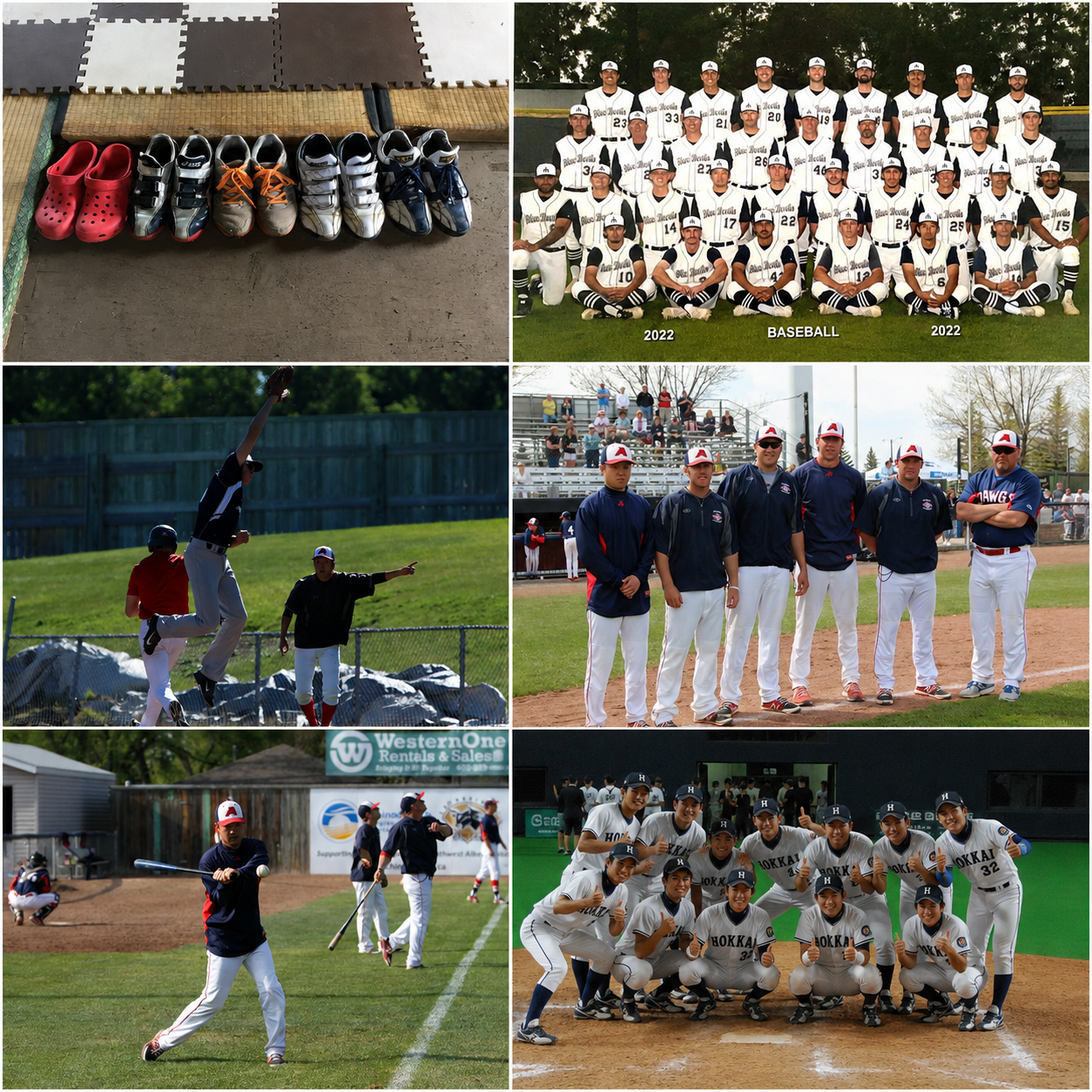
Canada was my first experience being part of a baseball team outside Japan. I joined Prairie Baseball Academy in Alberta as a guest coach, working with college players. As the only Japanese person on the team, I struggled with both language and cultural barriers. As a coach I could not let my performance on the field speak for itself. Instead, I built relationships through conversations with players and fellow coaches.
Compared with what I had experienced in Japan, the level of power and speed was higher, but the defense and baserunning seemed less refined. Those became my main areas of focus as I shared what I had learned in Japan.
A year went by quickly, and coaching in another country proved far more challenging than I had imagined. By the time I returned home, I still did not feel I had made a meaningful enough contribution.
The school where I went on to coach for almost four years was in a rural part of Japan and did not have a strong baseball program. But that also gave me the opportunity to become head coach right away and run the program according to my own approach.
We did not even have the nine players needed to field a team. We had just five, so we recruited students from the skating and basketball teams to help us compete in official games. I could not truthfully believe we would make it to Koshien, but I gave it everything I had, and the players did the same. Winning was difficult. Still, I wanted to make their three years worthwhile—to create an experience they could look back on and say they were glad they had played baseball here.
Because we had so few players, I often took them to practice alongside stronger teams. Those opportunities helped us improve, and in our final tournament, we finished as runners-up in the district. We did not reach Koshien, but I coached with the belief that those three years could help the players grow as people, whether we made it there or not. I am proud of what we achieved by finishing second in our district.
By now, you should also get the picture: I still was not done.
I moved to the United States and spent another three and a half years as an assistant coach at a community college in California.
Coaching in the United States felt easier than it had in Canada. I faced similar cultural and coaching challenges, but grew more comfortable.
I was just a young coach from Japan, surrounded by other coaches who all had played at the college. It would take time for my ideas to gain acceptance. The head coach already had an established approach to throwing and hitting, but I again saw a lane for me in helping with baserunning and outfield defense.
The baserunners struggled to read batted balls, so I used batting practice to give them repeated opportunities to improve their reads. I also encouraged them to steal more aggressively. With the outfielders, I emphasized charging balls hit in front of them and turning their heads away from the ball as they ran back on balls hit over their heads. The outfielders at the community college were hardly specialists at the position. That also meant they had plenty of room to grow. They picked things up quickly, and the team became much more productive.
I also had players pick up trash in the dugout after games and encouraged them to pay closer attention to what was happening around them. There was a cultural dimension to this, so it was difficult to make it a consistent habit. Still, some coaches and players understood the thinking behind it and put it into practice.
Over time—and before I realized it—I had become one of the people from my high school team who'd stayed in the game the longest. If I'd been the star, if I'd played at Koshien, I doubt I ever would have crossed the world twice chasing the game.
Compared with those twelve-hour practice days, the yips, and repeatedly failing to make the roster, almost anything feels manageable. Even coaching in a new language and being immersed in a culture that was far from my own. It gave me a far wider feel for the game than I ever would have found staying in one spot.
Part VI:
With all my time spent on the diamond, I began to realize how experiencing failure and struggle in our younger years is foundational. Maybe it is more important to face difficulty and work to overcome it than to succeed at everything from the beginning. Especially in baseball.
Today, life flows differently. I am a new father. My family and I still live in the north of Japan, and I am working at a university.
I am not on a field everyday leading baserunning drills or hitting fungos for the next generation.
But I am continuing to ask myself: what can I do to grow the game and contribute? How can I pass along the same wisdom I learned from the coaches I learned from, for developing players from around the world?
Beyond just covering statistical analysis or NPB predictions, what can my writings and experiences teach others – about this deep and unshakable connection to baseball, to baseball in Japan, and to life in general?
I do not have all the answers for what’s next. But what I do know is this:
If I run from it, it will chase me.

.png)